Your Brain on Burnout: What's Actually Happening
When exhaustion stops being about tiredness and becomes something your nervous system seems stuck in. A brain-coaching perspective on what changes, what the research suggests, and what helps.
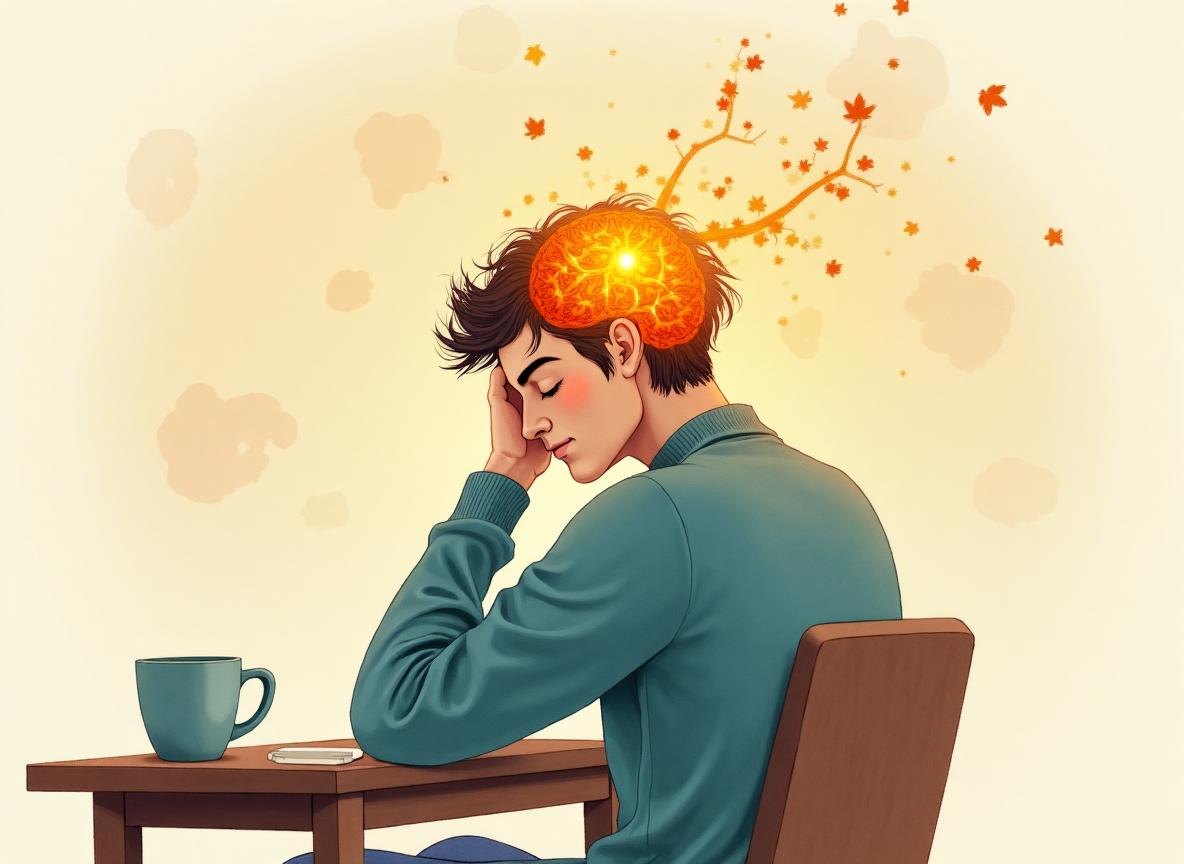
When exhaustion stops being about long hours and becomes something deeper. What changes, what the research suggests, and what actually helps.
I work with a lot of high-performing adults. Founders, senior leaders, people who have spent years building careers they care about. And almost all of them, when they first come to me, describe the same thing.
“I don’t know what happened. I used to thrive on this pace. Now the thought of another quarter makes my chest tighten.”
You wake up already tired. Decisions that used to take five minutes now take forty. The things that made you good at your job, pattern recognition, instinct, the ability to hold complexity and act on it, feel like they have left the building. You are still turning up. You are just not really there.
Most people treat this as a resilience problem. Push harder, sleep more on the weekend, book a holiday, come back refreshed. Sometimes that works. Often it does not, and the reason it does not is hiding in plain sight. What looks like a resilience problem is often something else entirely. It is a system problem. Specifically, a nervous system that has forgotten how to return to recovery.
What we mean by burnout
Before we go further, one thing matters. Burnout is not the same as a difficult month. The World Health Organization classifies it as an occupational phenomenon, not a medical condition, arising from chronic workplace stress that has not been successfully managed. In the Netherlands and Sweden the picture is a little different: GPs there diagnose and manage exhaustion-type syndromes under national guidelines. So whether “burnout” is a formal label depends on where you live and what system is doing the labelling.
What I am writing about here is the experience: persistent exhaustion, cynicism or detachment from work you used to care about, and a growing sense that nothing you do is enough. If those feelings are intense, lasting, or interfering with your ability to function, the right first step is a GP or qualified mental-health professional. Brain coaching works alongside that kind of care, never instead of it.
The alarm that does not switch off
Here is where the brain science gets interesting, and where I want to be careful about what the research actually says.
Deep in the brain sits a small structure called the amygdala. One of its jobs is to scan for threats and trigger the body’s alarm response. When it fires, stress hormones like cortisol and adrenaline are released, your heart rate rises, your attention narrows. This is a good thing in the right moment. It is an ancient survival system, and it works.
The problem, as many clinicians describe it, is that under chronic stress this alarm can become hypersensitive. It starts firing not just at genuine threats but at anything that feels like pressure: a difficult email, a board meeting, a sideways comment in a review. Each one can provoke a disproportionate stress response, even when nothing physically dangerous is happening.
Much of this work comes from chronic-stress research, including animal studies. Human burnout studies show associations rather than proof of cause. We cannot say “this is exactly what is happening in your brain.” But the pattern clinicians see again and again, in founders, in leaders, in anyone carrying sustained pressure without enough recovery, is a stress-response system that has got stuck in the “on” position.
When perspective disappears
There is another region that matters here. The prefrontal cortex, sitting behind your forehead, is involved in planning, perspective-taking, and regulating our response to the amygdala’s alarm. It is the part of you that can step back and ask, “Is this actually a threat, or am I overreacting?”
Research suggests that under chronic stress, this regulatory connection gets weaker. You do not lose the ability to think rationally. You lose the ability for that rational thinking to calm the alarm down. Leaders describe this as making decisions they know are reactive, knowing in the moment that the decision is driven by something other than good judgement, and being unable to stop themselves.
The brain-coaching frame for this is simple and, I think, more useful than pathology: behaviours that look like flaws are usually a brain doing exactly what it was wired to do under specific conditions. Change the conditions, and the behaviour shifts.
Why decision-making collapses too
This is the part I find most interesting, and the part senior leaders are often most surprised by.
When the stress system is stuck on, decision-making changes too. Not just the strategic decisions. The small ones. What to prioritise, whether to reply to a message now or later, whether to defer a difficult conversation for another week.
The neuroscientist Antonio Damasio spent years studying this. His hypothesis, built on work with patients who had damage to brain regions where emotion and reasoning intersect, is that we do not actually make good decisions through pure logic alone. We rely on what he called somatic markers, body-based signals that tag options with a feeling of “this is worth pursuing” or “something feels off here.” The patient findings are striking: people with intact logic and memory but disrupted emotional signalling made catastrophically poor decisions despite being able to explain, intellectually, what they should have done.
Damasio’s broader mechanism is still debated, and some replications are mixed. That work was done with people who had specific brain injuries, so it does not show that exhaustion disables intuition. What it does suggest is that judgement is not pure logic, and that is worth holding onto for anyone whose job depends on judgement under uncertainty. When you are chronically exhausted, the quieter signals, the intuitions, the gut sense that something is right or wrong, seem to get drowned out. You either overthink everything because nothing feels certain, or you default to whatever stops the discomfort in the moment.
This is not a character flaw. It is not a failure of willpower. It is what happens when the conditions the brain needs for good decision-making are not being met. And for leaders, whose decisions affect not just themselves but the people they are responsible for, that cost compounds.
The cost that does not show up in a performance review
Most organisations do not have a line item for this. They track output, deadlines, revenue, engagement scores. They rarely track decision quality, strategic patience, or the slow erosion of judgement that comes from a nervous system running on empty.
But I see a version of it in most leaders who come to me in this state, and I want to be clear that this is a coaching observation, not a diagnostic pattern. It usually looks like this: good at the job for years, then a slow drift into reactive decision-making, avoiding the hard conversations, deferring the strategic work, reaching for quick wins instead of doing the patient thinking the role actually needs. They know something is off. They just cannot fix it by working harder, because working harder reloads the same conditions that produced it.
Three things that seem to help
I am cautious about lists that promise fixes. What I can share is what the research points toward and what I see working with clients, with the caveat that everyone is different and none of this replaces professional support.
Breathing. The breath is one of the few body functions under both automatic and conscious control. A slow exhale, longer than the inhale, appears to signal to the nervous system that the immediate threat has passed. Four seconds in, six seconds out, for a few minutes between meetings. It is not magic. It is a lever, and it costs nothing.
Movement, nature, and real connection. The things that help a stuck nervous system are often physical and relational. Walking, especially outdoors. Real conversation with someone who actually listens, not a transactional update. Time in green or blue space. In the framework we use at LeSel, these sit across three of the six pillars we look at with every client: Movement, Relationships, and Nature. They are not soft skills. They are operating conditions.
Redesigning the system, not just resting. Rest alone rarely fixes this, because the moment you return to the same conditions, the same load, the same lack of recovery, the pattern starts again. The work is building recovery into the structure of the week. Not as a reward for pushing hard. As infrastructure. The leaders I see recover are not the ones who took the longest holiday. They are the ones who changed how their week is built.
The shift that matters
Most of the high-performing adults I work with who have been through burnout share one thing. They treated rest as something you earn by breaking yourself first. Recovery was an emergency response, not a daily practice.
What actually seems to make the difference is treating recovery the way you treat strategy. A small, consistent, daily investment. Not a dramatic overhaul. A walk between meetings. A real conversation. Ten minutes of breathing before a difficult decision. These things compound. Not because of neuroscience. That framing comes from a maths analogy about consistency, not from brain research. They compound because you are teaching your nervous system, gently and repeatedly, that the threat has passed and it is safe to return to the state where clear thinking, strategic patience, and good judgement actually live.
A note on the science
I want to be honest about the limits here. Burnout research is active and evolving. Some of the frameworks clinicians use, like polyvagal theory or models of brain-layer hierarchy, are widely used in therapy rooms but contested in mainstream neuroscience. Cortisol findings in burnout are genuinely mixed: raised, flattened, and reduced patterns have all been reported. There is no hormone test that identifies burnout.
What the research does point to, fairly consistently, is that chronic stress changes how the stress-response system behaves, and that these changes affect energy, mood, focus, and decision-making. The good news, and the reason I do this work, is the same plasticity that lets the brain adapt to stress also lets it adapt to recovery. The brain that wrote the pattern can rewrite it, given the right conditions and enough time.
If you are dealing with persistent exhaustion, detachment from work you used to care about, or a sense that nothing you do is enough, please talk to a GP or qualified mental-health professional. Brain coaching is not a replacement for therapy and it is not a quick fix. It works alongside that kind of care, never instead of it.
If you would like a structured look at your current pressures, your recovery habits and the six lifestyle pillars, you can start a Brain Profile. It is an educational coaching report, not an assessment or a diagnosis. It is free to start, and the full profile with a four-week action plan is €39, credited toward a €111 first session. Or book a session to talk about what recovery could look like for you. You can also explore our For Yourself page, or read more on why you can’t focus anymore.
Linda-Lotte Seligman
Certified Brain Coach, Founder of LeSel
Want to put this into practice?
Two ways. The free Brain Profile is a personalised brain-science read on what's actually going on. A 1:1 session with Linda-Lotte is the deeper option.